8 Best Geography Toys for Homeschool Fun
A child who can point to Texas on a map but cannot remember whether it is north, south, east, or west has not failed geography. They simply need more chances to play with the map! The best geography toys for homeschool turn places into familiar friends through puzzles, games, matching, storytelling, and plenty of cheerful repetition.
That matters because geography is much more than memorizing capitals. It is the skill of understanding where we are, how places connect, why climate changes, where people live, and what makes one region different from another. A good toy makes those big ideas feel manageable. Better yet, it gives kids a reason to come back tomorrow and do it again.
What Makes a Geography Toy Worth Using?
Not every map-themed activity earns a permanent place on the homeschool shelf. Some toys look colorful but only ask children to place one piece correctly. Others pack in so many facts that kids lose the fun before the learning begins. The sweet spot is a toy with a clear goal, hands-on action, and enough replay value to make practice feel like a game night choice instead of an assignment.
Look for four things when choosing geography toys: an age-appropriate challenge, accurate and easy-to-read visuals, a format your child already enjoys, and room to grow. A kindergartner may love sorting land and water or building a simple state puzzle. An older child may be ready to compare flags, trace rivers, identify capital cities, or explain why mountain ranges affect weather.
It also helps to choose toys that invite conversation. If your child lands on Alaska, ask what they notice. Is it connected to the other states? What might the weather be like? Which animals live there? One little question can turn a correct answer into real curiosity.
8 Best Geography Toys for Homeschool
1. U.S. Map Puzzles
A sturdy U.S. map puzzle is a homeschool classic for a reason. Children physically place states beside their neighbors, which helps them build spatial memory rather than simply recite a list. Look for a puzzle with state names, capitals, major landmarks, or state symbols printed directly on the pieces.
For younger learners, start with the border states and the states where relatives live. For older kids, make it a friendly challenge: pick five states, place them without looking, then name something each one is known for. My Mini Map from KosoGames is especially handy for this kind of playful practice because kids can see the country take shape piece by piece without facing a giant, overwhelming puzzle.
The trade-off is that a U.S. puzzle mainly teaches location. Pair it with books, stories, or games when you want to explore culture, history, and physical geography in more depth.
2. World Map Floor Puzzles
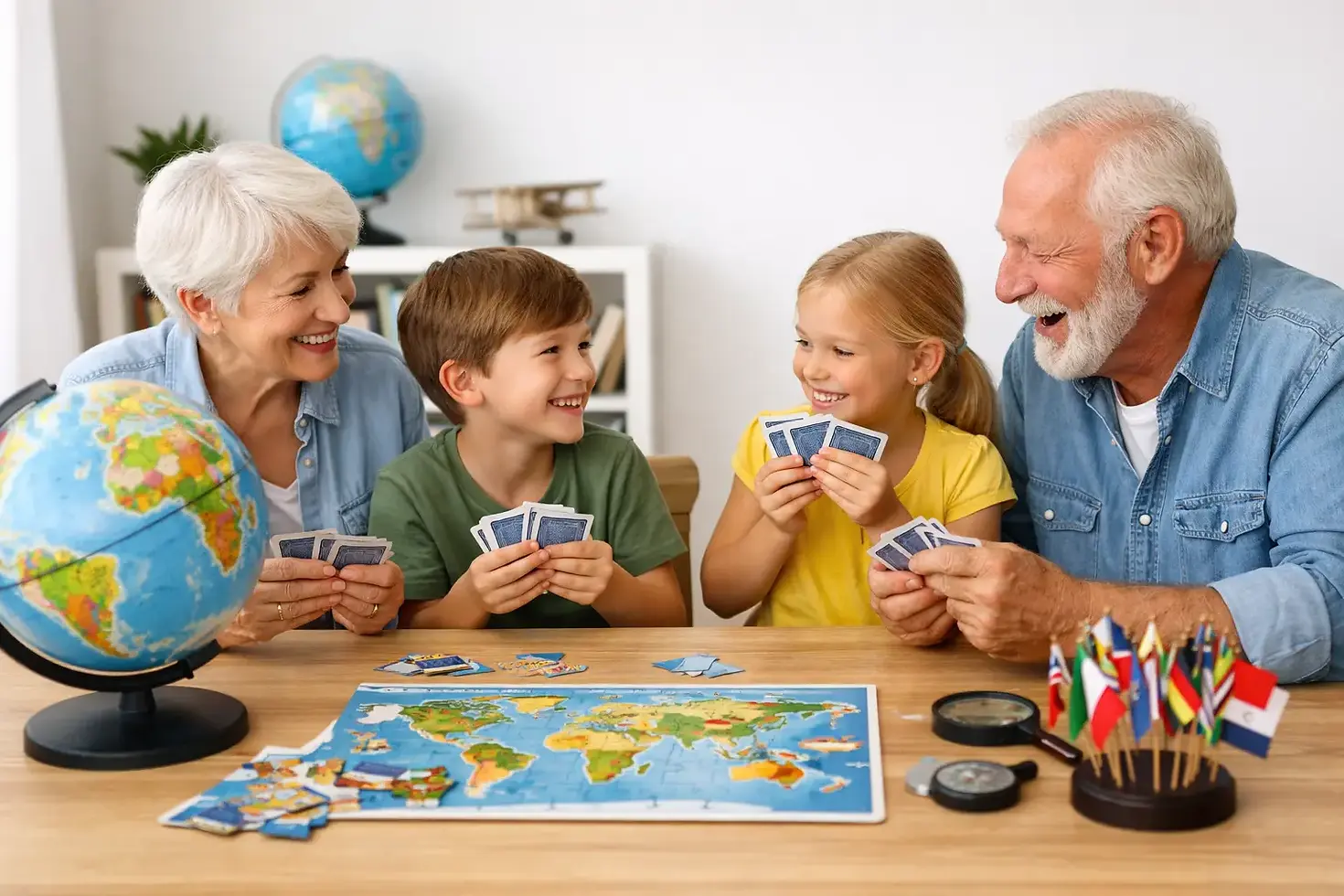
A world map floor puzzle gives geography a bigger stage. Spread one out after breakfast, and suddenly oceans, continents, countries, animals, and famous landmarks are part of the day. Large pieces work well for younger children, while detailed puzzles can hold the attention of upper elementary students who enjoy a real challenge.
Use the completed map as a launchpad for your homeschool week. If you are reading a folktale from Japan, find Japan. If dinner includes tacos, find Mexico. If an animal documentary features penguins, head south to Antarctica. Geography sticks faster when it keeps showing up in ordinary life.
Be aware that some children get frustrated with puzzles that have lots of similarly colored ocean pieces. If that sounds familiar, choose a map with clearly defined borders and illustrated landmarks rather than a highly detailed political map.
3. Geography Card Games
Card games are a sneaky-smart choice for homeschool families because they are easy to repeat. A deck can come to the kitchen table, the waiting room, a sibling’s sports practice, or a grandparent’s house. That flexibility is gold when lessons do not always happen at a desk.
The best geography card games ask children to do more than identify a picture. They may match countries to flags, compare facts, collect regional sets, identify landmarks, or answer clues about a place. Familiar rules are a bonus. When kids already know how to take turns, ask for a card, or collect a set, they can focus their energy on the learning instead of mastering complicated directions.
Choose cooperative play if competition causes meltdowns, especially with younger siblings. You can also create a team version: everyone works together to collect a set of continents, landforms, or state facts before the deck runs out.
4. Globe Balls and Toss Games
A globe ball is one of the most joyful ways to make geography active. Toss the ball, catch it, and name the country or ocean beneath your thumb. Add a prompt such as, “What continent is it on?” or “Would you expect it to be hot, cold, or somewhere in between?”
This format is excellent for kids who learn by moving. It is also wonderfully low-pressure. Nobody has to sit still, fill out a worksheet, or know every answer right away. The goal is exposure, laughter, and another chance to see the same names.
Globe balls are less precise than a wall map or puzzle, so they are best for broad world awareness rather than detailed study. Think of them as a warm-up game, a brain break, or a quick review before heading outdoors.
5. Magnetic Maps
Magnetic maps add the satisfying click of building and sorting. Depending on the set, children can place states, countries, continents, landmarks, weather symbols, or flags on a board. This makes them useful across several ages. A younger child can simply match shapes and colors while an older sibling organizes regions or labels capital cities.
They are particularly helpful for visual learners who like to move pieces around before committing to an answer. Try removing a few magnets each day and asking your child to restore them. Once that feels easy, ask them to explain what borders each place or what body of water sits nearby.
A small caution: magnetic sets often include tiny pieces. They are terrific for independent work with school-age kids but should be stored safely around toddlers.
6. Landmark Building Kits
Building the Eiffel Tower, the Great Pyramid, a lighthouse, or a famous bridge gives children a memorable connection to a place. Landmark kits are not a complete geography curriculum by themselves, but they make an excellent companion to a country study or world history unit.
As your child builds, talk about where the landmark is located, what climate it has, and how people travel there. Pull out a map and trace the route from your home. This naturally introduces scale, distance, oceans, and neighboring countries without making the lesson feel heavy.
Choose simpler kits for younger builders. Complex models can be rewarding for older children, but if assembly becomes frustrating, the geography conversation may disappear under a pile of tiny parts.
7. Flag Matching Games
Flags are bright, bold, and wonderfully collectible. A flag matching game can help children notice patterns in color, symbols, and design while building familiarity with countries around the world. Kids often enjoy the detective work: Which flags have stars? Which ones use red, white, and blue? Which designs look completely different?
Flags do have limits. Recognizing a flag does not automatically mean understanding a country’s location or people. Make the game richer by placing each matched flag on a map or asking your child to name its continent. Keep the tone curious, too. Flags represent nations, but they cannot tell the whole story of the people who live there.
8. Map-Based Strategy and Adventure Games
For middle-grade learners, map-based adventure games can bring geography to life through routes, resources, travel decisions, and problem-solving. These games may involve crossing continents, planning a trip, delivering goods, or solving mysteries in different locations. They can strengthen map reading, critical thinking, and planning skills all at once.
This category depends heavily on your family. Some strategy games have longer rules and play times, which can be fantastic for a weekly family game night but not ideal for a 20-minute lesson between math and lunch. Read the age range honestly and save more complex games for when everyone has the energy to enjoy them.
Make Geography Toys Do More Than Fill Time
The magic is not in owning every kind of map toy. It is in using one toy often enough that children begin to recognize patterns. Keep a map puzzle accessible. Leave a globe ball in the living room. Bring out a card game on Fridays. Let kids choose the next country, state, or landmark to explore.
You can also build gentle routines around play. After completing a puzzle, each child shares one place they want to visit. During a card game, pause for one surprising fact. After a globe toss, find that location on a larger map. These tiny add-ons keep the game fun while helping facts settle into long-term memory.
The right geography toy does not need to turn your home into a miniature classroom. It just needs to make a child say, “Wait, where is that?” Once that question appears, you have a map full of possibilities.


Comments