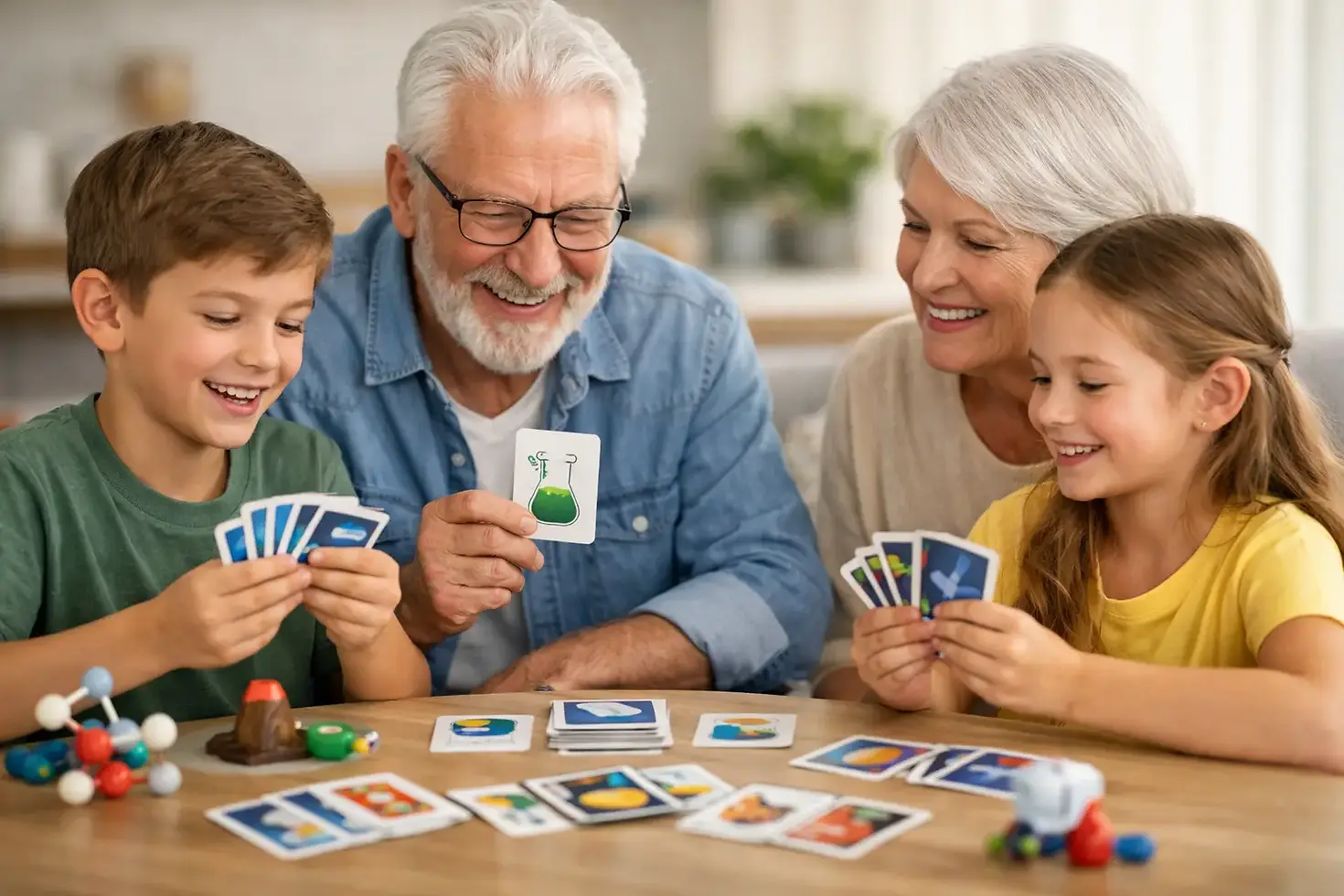
Best Science Card Game for Kids
Some games get played once, then disappear into the closet. A great science card game for kids does the opposite. It comes back out on rainy afternoons, family game nights, classroom break times, and those moments when you want something fun that does not end with another screen in everyone’s hands.
That is the real sweet spot for parents and gift-buyers. You are not just looking for a game that says “educational” on the box. You want one kids will actually ask to play again. And with science, that matters even more, because children are naturally curious. They already want to know why volcanoes erupt, how planets move, and what makes animals survive in extreme habitats. The right card game takes that curiosity and gives it a simple, playful structure.
What makes a science card game for kids actually work?
A lot of learning products have good intentions but bad timing. They feel too much like a quiz when kids want to relax, or too much like random entertainment when parents want real value. The strongest science card games live right in the middle. They keep the rules familiar, move quickly, and slip learning into the action instead of pausing everything for a lesson.
That is why card games work so well. Kids can focus on one small piece of information at a time. A fact about the solar system. A clue about reptiles. A category tied to chemistry, weather, space, or biology. Instead of being asked to master a whole topic at once, they build knowledge one turn at a time. That feels lighter, but it sticks.
There is also less pressure. In a workbook, a wrong answer can feel like failure. In a game, it is just part of the round. Kids hear facts repeated, connect ideas, and remember more than they realize. They are playing first, learning right alongside it. That is a big difference!
Why the Go Fish format works so well for science
Classic games stay popular for a reason. They are easy to learn, easy to teach, and easy to start. A child who already understands the basic rhythm of asking for cards, making matches, and paying attention to what other players have does not need a long explanation before the fun begins.
That familiar structure makes science feel approachable. Instead of introducing a totally new system, a science-themed card deck can layer facts, categories, and clues onto gameplay kids already know. The result is less confusion and more confidence. Children get the satisfaction of playing a real game while practicing memory, recognition, and recall.
This is where educational card games often separate into two camps. Some are packed with information but feel clunky. Others are smooth and playful but too thin on actual learning. A science game built around a classic format has an edge because the mechanics do not fight the content. The game carries the learning naturally.
For younger players, that means faster buy-in. For older kids, it means the game does not feel babyish just because it is educational. That balance matters if you are shopping for siblings, mixed ages, or family play.
The best science topics are concrete and memorable
Not every science topic lands the same way in a card game. The ones that work best usually give kids something vivid to picture or compare. Planets, dinosaurs, weather systems, habitats, human body facts, animals, and basic physical science concepts all tend to connect quickly because children can imagine them.
That does not mean abstract science is off limits. It just means the game has to present it in a way that feels graspable. A child may not get excited by the word “classification” on its own, but ask them to group animals by traits, environment, or diet, and suddenly they are in. The concept becomes active instead of distant.
Good science games also avoid making every card feel interchangeable. If the cards are full of bland labels with no clues, no surprises, and no sense of discovery, kids tune out fast. The best decks give each turn a little spark. Maybe a player hears a clue and thinks, “Wait, I know that one!” Maybe they remember a fact from last round and use it this time. That moment of recognition is where the learning really clicks.
What parents should look for before buying
If you are choosing a science card game for kids, start with replay value. Educational products often promise a lot, but if the game feels repetitive after one or two rounds, the learning opportunity disappears with it. A strong game should be simple enough to revisit often but varied enough that it does not feel stale.
Age fit matters too, but not always in the obvious way. A game that is technically “for kids” can still miss the mark if the vocabulary is too advanced for younger players or too basic for older ones. Mixed-age families usually do best with games that have easy rules and layered content. That way younger children can participate while older players still have something to think about.
It also helps to look at how the facts are delivered. Are they woven into the play, or pasted on as an afterthought? Kids can tell the difference. When the information drives the game, they stay engaged. When it feels bolted on, they start treating the educational parts like a speed bump.
And yes, design counts! Bright artwork, clear categories, readable cards, and a format that feels inviting all make a difference. Kids are more likely to grab a game that looks fun from the start.
Science learning that does not feel like schoolwork
This is the part families love most. A good science card game creates learning moments without announcing them with a giant spotlight. Kids are laughing, competing a little, paying attention, and repeating facts out loud. Then later, they surprise you by remembering which planet is known for its rings or which animal is a mammal rather than a reptile.
That kind of recall is powerful because it is tied to emotion and experience. Children do not just memorize an isolated fact. They remember hearing it during a funny round, using it to win a match, or calling it out before anyone else at the table. The memory has a hook.
This is also one reason screen-free games continue to matter. Digital learning tools can absolutely be useful, but card games bring a different kind of attention. Kids have to listen, watch, wait, ask, remember, and interact face to face. Those are learning skills too, and they travel well beyond science.
For homeschool families and classrooms, that makes card games especially handy. They can work as a warm-up, a review activity, a small-group station, or a quick reward that still keeps brains switched on. At home, they make a smart bridge between entertainment and enrichment without making the evening feel like homework hour.
Why simple beats complicated
There is a temptation in educational toys to overbuild. More rules, more layers, more exceptions, more features. Sometimes that works for older hobby gamers, but for most families, simple wins. If setting up the game takes longer than playing the first round, you are already losing momentum.
Simple does not mean shallow. It means the game gets to the good part quickly. Kids understand what they are trying to do. Adults do not have to reread instructions every time. Grandparents can join in. Siblings can teach friends. That ease is a feature, not a compromise.
It is one reason brands like KosoGames stand out in this space. Taking a familiar format like Go Fish and building subject learning into it is smart because it respects how families really play. You do not need a giant learning curve to create real educational value. You need a game that children enjoy enough to keep choosing.
The best gift is one that gets used
Science-themed gifts can be tricky. Some look impressive but end up collecting dust because they require too much setup, too much adult help, or too much patience at exactly the wrong moment. A card game has a better shot at becoming part of regular family life because it is portable, quick to start, and easy to repeat.
That makes it a strong choice for birthdays, holidays, classroom gifts, travel, and weekend visits with grandparents. It slips into the spaces where families actually need help most, those little pockets of time when kids want something fun and adults want it to be worthwhile too.
The best part is that children do not have to choose between play and learning. When a game is built well, those two things happen together. And that is where science gets exciting - not as a subject kids have to get through, but as a set of ideas they get to explore, one card at a time.
If you are picking a game for a curious kid, go for the one that keeps the rules friendly, the facts memorable, and the fun front and center. Kids cannot help but learn when they are busy trying to win!


Comments